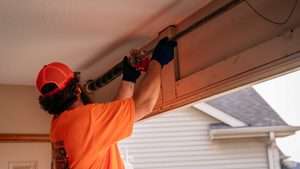
You press the button and nothing happens. Or the door starts down, then goes right back up. Or the motor hums and the door just sits there.
Some problems have a quick fix you can check yourself. Sometimes it’s a part that needs replacing. And sometimes the opener has simply reached the end of its life. Here’s how to tell which one you’re dealing with — and what you can safely check yourself before you call.
By the Fort Wayne Door & Dock team — serving Fort Wayne since 1974 · Last reviewed October 2026
WARNING: Garage door springs and cables are under extreme tension, and a door with a broken spring can drop suddenly. Either can cause serious injury. Never adjust springs, cables, force settings or travel limits yourself, and never open the opener’s motor housing. Stop and call a technician if the door is crooked, feels very heavy, or won’t reverse.
Nothing happens at all
Start here before anything else.
- Check the lock or vacation mode. Most wall controls have a lock button that blocks remotes from opening the door. It’s easy to bump by accident. Turn it off and try again.
- Check the power. Make sure the opener is plugged in. Plug a lamp into the same outlet — if the lamp doesn’t work either, check the breaker.
- Check the wall button itself. If the wall button works and nothing else does, skip to the next section.
Wall button works, but the remote or keypad doesn’t
- Replace the battery. It’s the first thing to check, especially once it gets cold — batteries lose power in low temperatures.
- Reprogram the remote. Remotes can lose their pairing with the opener. Your owner’s manual has the steps for your model.
- Try another remote. If one works and one doesn’t, the problem is the remote. If every remote and keypad has stopped working at once, the opener’s receiver or circuit board may be the issue — that’s a repair call.
The motor runs, but the door won’t move
If you hear the opener running but the door doesn’t budge, the opener has probably come disconnected from the door.
- Was the emergency release pulled? That red cord disconnects the door from the opener. Check whether the trolley on the rail is disengaged, and follow your owner’s manual to reconnect it — only with the door fully closed. If the door won’t stay closed or feels very heavy, don’t lift it; a spring may be broken.
- If it’s connected and still won’t move, the chain, belt or an internal gear may be broken or stripped. That’s a repair — and often a reasonable one, depending on the opener’s age.
The door reverses or stops partway down
- Look at the photo eyes first. These are the small sensors near the bottom of each side of the door. The light on each should be steady, not flashing. Wipe the lenses, make sure nothing is blocking the beam, and check that neither sensor got bumped out of line.
- If the sensors look fine, the opener’s travel limits or force settings may be off, or the door itself may be binding. Leave those to a technician. LiftMaster’s own manual warns: “Do not use force adjustments to compensate for a binding or sticking garage door.” Too much force can keep the door from reversing when it should — which is the whole point of the safety system.
Cables, rollers or tracks look wrong

If a cable looks frayed or loose, a roller has come out of the track, the track is bent, or the door hangs crooked, stop using the door and call for service. Cables and bottom brackets are under spring tension, and a door that’s off its track can fall. This isn’t a DIY fix.
The opener strains, slows down or groans
This one is often the door’s fault, not the opener’s. Your springs are supposed to do almost all of the lifting — the opener just guides the door. When a spring wears out or breaks, the opener is suddenly trying to lift dead weight.
Don’t keep running it, and never try to adjust or replace a spring yourself. Read more in How Long Do Garage Door Springs Last? If it’s cold out, stiff grease can also slow things down.
Brand-specific notes
We service all major opener brands, including these three. (Brand names are trademarks of their respective owners.)
- Genie: Genie openers have a “Sure-Lock” or vacation lock on the wall console. If nothing responds, make sure it’s off.
- LiftMaster: Check the lock button on the wall control first. Many newer LiftMaster models work with the myQ app — if the app shows an error but the wall button works, the problem is more likely the Wi-Fi connection than the opener itself.
- Chamberlain: Most of the same checks apply: lock button, remote battery, reprogramming, photo eyes.
Out in the country: power outages and cold keypads
If you live out toward Leo-Cedarville, Grabill or Harlan, two opener problems tend to show up more than they do in town.
Power outages. Rural power lines tend to run longer distances, often through trees, which can leave them more exposed to storms. Nationally, customers of rural electric co-ops averaged nearly five hours without power in 2015, compared with a little over three hours for customers of investor-owned utilities, according to the U.S. Energy Information Administration. Those are national averages; your own utility and the line to your house matter more. Northeast Indiana has had its share this year: a March 13 windstorm knocked out power to more than 5,500 Indiana Michigan Power customers in Allen County, and Northeastern REMC reported about 2,600 outages at the peak.
When the power’s out, so is your opener. A couple of things help:
- Know where your emergency release is before you need it. That’s the red cord hanging from the opener rail. Pull it only with the door fully closed, then lift the door by hand. If the door feels very heavy, stop — a spring may be broken.
- Ask about battery backup. Many newer openers can run on a backup battery during an outage. Genie, for example, says its backup units handle up to 50 open-and-close cycles in the first 24 hours. We can tell you whether your opener supports one.
Keypads and remotes in the cold. Out here, it’s common to have a detached garage or a pole barn, and those often aren’t heated. That’s hard on batteries: standard alkaline batteries are rated down to about 0°F, and their output drops well before that. If your keypad or remote gets sluggish once winter sets in, start with fresh batteries in the fall.
How long do garage door openers last?
A common rule of thumb is 10–15 years with good maintenance, and closer to 7–10 with heavy daily use. There’s no hard expiration date: a well-maintained opener can run longer, and one that’s lifting an unbalanced door every day can wear out sooner.
Signs yours is near the end: it’s getting louder, it needs repairs more often, parts are hard to find for your model, or it doesn’t have the safety-reverse features described below.
Repair or replace?

Plenty of openers are worth repairing. A worn gear, a failed sensor or a bad remote is usually a straightforward fix. But a few things point toward replacement:
- Age. An older opener that needs a major part may not be worth putting money into (see lifespan above).
- No safety reverse. Under federal rules, openers made since January 1, 1991 must reverse when the closing door hits something, and those made since January 1, 1993 must also have a second layer of protection, such as photo-eye sensors near the floor, so the door doesn’t close on a person, pet or car. If yours is older than that or doesn’t reverse, the door industry’s trade association recommends considering a replacement. It’s a safety issue, not a cosmetic one.
- Repeated repairs. If you’re paying for repairs again and again, ask for a side-by-side price on repair versus replacement.
- Features you want. Quieter belt drives, wall-mount openers that free up ceiling space, battery backup for power outages, or smartphone control.
We’ll give you an honest answer either way. If a repair will do the job, that’s what we’ll recommend.
A 1-minute monthly safety check
The door industry recommends testing your opener’s auto-reverse every month. Follow the test in your owner’s manual — it typically means laying a small block of wood flat under the center of the door and closing it, with people, pets and cars kept clear. The door should reverse when it touches the block. If it doesn’t, stop using the opener and call for service.
Garage door opener FAQ
Why does my garage door opener work from the wall button but not the remote?
Usually the remote’s battery, or the remote has lost its pairing with the opener. Replace the battery first, then reprogram it using your owner’s manual. If every remote stopped at once, the opener’s receiver may need service.
Why does my garage door go back up when I try to close it?
Most often the photo-eye sensors near the floor are dirty, blocked or knocked out of line. If they’re clean, lit and lined up and the door still reverses, call a technician to check the door and the opener’s settings.
Why does the opener run but the door doesn’t move?
The emergency release may have been pulled, disconnecting the door from the opener. If it’s connected and still won’t move, a gear, chain or belt may be broken.
How long do garage door openers last?
A common rule of thumb is 10–15 years with good maintenance, and less with heavy daily use.
How much does garage door opener repair cost?
Our pricing page lists opener repairs starting at $100 for the first hour, plus the service call, parts, and applicable tax. Repairs start with an on-site diagnostic visit, and we’ll explain the expected price before repair work begins.
Should I repair or replace an old opener?
If it’s a simple part and the opener is in good shape, repair usually makes sense. If it’s old, needs a major part, or has no safety reverse, replacement may be the better call. Ask for both prices and decide from there.
We’re already next door
Northeast Allen County is its own corner of the map. It’s buggies on Grabill Road and fog lifting off Cedarville Reservoir on a fall morning. It’s newer neighborhoods near Riverside Gardens Park and Leo Jr/Sr High, farms and pole barns along State Road 37 out past The Country Shoppes of Grabill and Hurshtown Reservoir, the east side around Georgetown Square and Shoaff Park, and Broadway in New Haven.
We’ve been serving Fort Wayne since 1974, and our technicians work this part of the county regularly. When your opener quits on a January morning in Leo or Harlan, you’re calling a local team that already knows these roads.
General information only. Your opener, door and local code may differ. Follow your owner’s manual, and when in doubt, call a trained garage door technician.
Need a hand?
Fort Wayne Door & Dock handles garage door opener repair for all major brands — Genie, LiftMaster, Chamberlain, Guardian, Craftsman and more — even if we didn’t install it. We serve Leo-Cedarville, Grabill, New Haven and all of Fort Wayne.
Our technicians aren’t salespeople. We diagnose the problem, give you the price, and you approve it before any repair work begins. Repairs start with an on-site diagnostic visit (a trip fee applies). No games. No surprise bills.
Schedule service online or call 260-305-8805. Door stuck open? Call our emergency line at 260-727-8866.