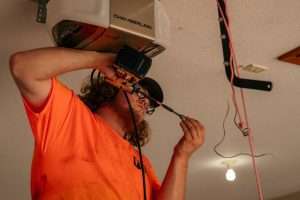
A lot of the time, it happens on a cold morning. You hear a loud bang from the garage. Nothing fell off a shelf. That was your garage door spring snapping.
- If you live in Leo-Cedarville, Grabill, or northeast Fort Wayne, a broken garage door spring can be an unexpected headache, especially as temperatures begin to drop.
- Fort Wayne experienced an unusually wet late summer in 2026, including its fifth-wettest August on record and its wettest September since 2016. With colder weather approaching, it’s a good time to understand how long garage door springs last, what causes them to break, and when replacement may be necessary.
By the Fort Wayne Door & Dock team — serving Fort Wayne since 1974 · Last reviewed October 2026
WARNING: Garage door springs and cables are under extreme tension. If one breaks or is released, it can cause serious injury. Do not adjust, loosen, remove or replace springs, cables or bottom brackets yourself — call a trained garage door technician.
How long do garage door springs last?

Most standard torsion springs are rated for about 10,000 cycles. One cycle is one trip up and one trip down.
That sounds like a lot until you do the math:
- 2–4 cycles a day (leaving in the morning, coming home at night, or running errands): roughly 7–14 years.
- 6–10+ cycles a day (busy families, kids coming and going, or households that use the garage as their main entrance): roughly 3–5 years.
If your garage door springs are several years old and have never been replaced, consider how often you use your door. Springs wear with each opening and closing cycle, so frequent use can shorten their lifespan. Higher-cycle springs (20,000–25,000 cycles) are also available. If you need replacements, ask your technician whether they’re a good fit for your household.
Why garage door springs break
Springs don’t break all at once. They wear out over years, and the snap is just the last second of a long process.
- Every open and close flexes the steel. Garage door springs are made of high-carbon spring steel, and each cycle bends the wire. The stress is highest right at the surface of the wire.
- A tiny crack starts at the weakest spot. That might be a scratch, a mark from manufacturing, or a small rust pit.
- The crack grows a little with every cycle. For years, you can’t see it.
- Eventually there isn’t enough solid steel left to hold the load. The spring snaps — usually while the door is closed, because that’s when the spring is wound tightest.
Two things speed this up: rust, which gives cracks a head start, and hard cold snaps, which make steel less forgiving. Cold doesn’t cause the damage, but it can be the final straw for a spring that’s already worn.
Why northeast Allen County garages are harder on springs
Rust is one of the main things that speeds up spring wear, and rust needs bare steel and moisture. A few things about life between Leo-Cedarville, Grabill and New Haven give it more of both.
Road salt rides home with you. Commutes on State Road 1, State Road 37, and county roads bring a winter’s worth of salty slush into your garage. As that slush dries, salt residue can become part of the dust circulating through the space. When it settles on metal surfaces, including overhead garage door springs, it can contribute to corrosion in damp conditions.
Farm air is hard on metal. Around Grabill and Harlan, a lot of garages sit near barns, share a wall with a pole barn, or store fertilizer and lawn chemicals. Ammonia from livestock and fertilizer mixes with moisture to form a compound that attacks most metals, and farm dust speeds the process up.
River-valley dampness. The St. Joseph River, Cedarville Reservoir and Cedar Creek run right through the Leo-Cedarville area. On cool nights after a wet stretch — like this fall — river valleys hold onto damp air, and a cold steel spring is where that moisture condenses.
The cold snap is the final straw
Cold doesn’t wear out a spring, but it makes steel less forgiving. When the temperature drops hard, a spring that’s already cracked from years of use and rust can give out on the first bitter morning instead of holding on until spring.
Fort Wayne knows those mornings. The city hit a record −13°F on January 30, 2019, and on December 23, 2022 it dropped from 39°F to −8°F in just 18 hours. Forecasters expect a milder-than-normal winter this year, but even mild winters bring sudden cold snaps.
Warning signs of garage door spring problems
Here are some signs that your garage door springs may need attention:
- Rust or flaking on the spring coils. Especially orange streaks or pitting.
- A visible gap in the coil. That’s a spring that has already broken.
- The door feels heavy or unbalanced — for example, the opener labors to lift it. Don’t disconnect the opener to test the door yourself if you suspect a spring problem; a technician can check the balance safely.
- The opener strains, slows down or reverses partway up.
- The door goes up crooked or slams down instead of settling gently.
- Squeaking or grinding from the springs every time the door moves.
Broken garage door spring? What to do (and not do)

The springs do almost all of the lifting. With one broken, your door is suddenly a few hundred pounds of dead weight.
- Don’t run the opener. It isn’t built to lift the full weight of the door and can burn out or strip its gears.
- Don’t try to lift the door alone. Without spring tension it can drop fast and hard.
- Don’t try to replace the spring yourself. Torsion springs are wound under extreme tension, and winding them without the right tools and training is how people get badly hurt.
- Do keep people, pets and cars clear of the door until it’s fixed.
- Do call for service. If your car is stuck inside or the door won’t close, use our emergency line: 260-727-8866.
Get ahead of it this fall
A little maintenance before winter can help you spot potential problems early:
- Schedule garage door maintenance before winter. A technician can check for visible damage, while the spring’s age and frequency of use can help estimate how close it is to its rated cycle life.
- Hose or wipe salt slush off the garage floor during the winter instead of letting it sit.
- Keep fertilizer, pool chemicals and lawn treatments in a sealed bin or out of the garage.
- Ask whether high-cycle springs fit if your household has three cars or the garage is your main door.
Garage door spring FAQ
How long do garage door springs last? Most standard springs are rated for about 10,000 cycles. At 2–4 cycles a day, that’s roughly 7–14 years. Heavily used garage doors may need spring replacement sooner, sometimes within 3–5 years.
Can I open my garage door with a broken spring?
Not safely on your own. With a broken spring, the door is a few hundred pounds of dead weight and can drop without warning. Don’t run the opener and don’t try to lift it alone. If your car is stuck inside, call our emergency line at 260-727-8866.
Can I replace a garage door spring myself?
We don’t recommend it. Springs are wound under extreme tension, and replacing them takes the right tools and training. It’s one of the most dangerous jobs on a garage door.
What’s the difference between torsion and extension springs?
Torsion springs sit on a metal bar above the door and twist to lift it. Extension springs run along the tracks on each side and stretch. Both store a lot of energy, and both are a job for a technician.
Why do garage door springs break?
Metal fatigue. Every cycle flexes the steel, a tiny crack eventually forms, and it grows until the spring snaps. Rust gives that crack a head start, and a hard cold snap can be the final straw.
How much does garage door spring repair cost?
Replacing one standard residential torsion spring costs $295 plus tax, while replacing two costs $400 plus tax. Extension spring replacement falls between those prices, and larger or special-order springs may cost more.
We can provide a ballpark estimate over the phone based on your description of the problem. If additional repairs are needed, our technician will explain the costs before proceeding.
Your neighbors in northeast Allen County
We know this part of the county because we live and work here. Our technicians are out here regularly — in the newer neighborhoods spreading out from Cedarville Reservoir, near Leo Jr/Sr High and Riverside Gardens Park, on the farm roads around Grabill and Harlan where passing an Amish buggy is just part of the drive, out by Hurshtown Reservoir and the Spencerville Covered Bridge, and along Broadway and past Moser Park in New Haven.
It’s a place where garages work hard: they hold the trucks, the mowers, the feed and the fertilizer, and plenty of them get opened all day long. That’s why we wrote this. Fort Wayne Door & Dock has been taking care of garage doors here since 1974, and when a spring snaps on a cold morning in Leo-Cedarville, our technicians already know the way.
Fort Wayne Door & Dock provides garage door repair in Leo-Cedarville, garage door service in Grabill, and spring repair across New Haven and northeast Fort Wayne. Our technicians aren’t salespeople. When you call, we’ll discuss the issue and provide a ballpark estimate or explain our hourly rates. Once you’re ready to proceed, we’ll send a technician to assess the door and make the necessary repairs. If additional problems come up that would significantly increase the cost, we’ll explain them and get your approval before continuing. We believe in honest pricing and keeping you informed every step of the way.
If your springs are rusty, noisy, or showing signs of wear, schedule service online or call 260-305-8805. Already heard the bang? Call our emergency line at 260-727-8866.
General information only. Your door, springs and local code may differ. When in doubt, call a trained garage door technician.